
Cuyahoga Falls City Directory Collections
Historical directories for Cuyahoga Falls are spread across a local-history project, library holdings, and metropolitan volumes. The local starting point is the Cuyahoga Falls History directory-and-map collection, which posts digitized material from 1859 through 1891. It includes business-directory posts for 1859-60, 1875-76, and 1877-78. Those items are historical evidence for the year printed, not a current list of residents. For later years, the Akron-Summit County Public Library, often called ASCPL, provides the broader directory route. Its Historic City Directories page cautions that Cuyahoga Falls appears in most volumes, so the reader should open each Akron-titled volume and confirm the local section.
| Collection or route | Years documented | Where to use it | Best evidence |
|---|---|---|---|
| Cuyahoga Falls History directories | 1859-1891, including business years | Digital local-history collection | Printed name, street, and business context |
| Williams directory | 1859, C. S. Williams | ASCPL digitized route | Early Cuyahoga Falls name and street evidence |
| Digitized Akron-Summit series | 1859, 1868, 1871-72 through 1920 with listed exceptions; selected later years through 1969 | ASCPL and linked collection | Name, address, business, or street sections when locally included |
| Burch Official City Directory examples | 1939-40, 1948-49, 1964-65, and 1968-69 | ASCPL collection and staff referral | Later metropolitan Cuyahoga Falls coverage |
| Haines criss-cross volumes | Later editions, exact years unpublished | ASCPL Special Collections research room | Address-to-listed-name route where present |
The Cuyahoga Falls History directory collection is the clearest entry point for early local material. ASCPL supplies a much longer digitized series, but a continuous publishing list is not proof that every volume includes Cuyahoga Falls. Record the title page, year, and local section actually inspected.
Cuyahoga Falls Directories From Williams to Burch
The printed trail begins with Williams' Akron, Wooster and Cuyahoga Falls Directory of 1859, credited to C. S. Williams. It then moves through Akron-area publishing, including Burch, Potter & Co. in 1875-76, N. H. Burch & Co. in 1882-83, and The Burch Directory Co. examples later on. The 1939-40 Burch volume is supplemented by Barberton and Cuyahoga Falls directories. The 1948-49 title explicitly includes Akron, Tallmadge, Portage Lakes, Barberton, and Cuyahoga Falls. Burch editions for 1964-65 and 1968-69 explicitly name Cuyahoga Falls as well.
That Williams-to-Burch sequence gives a researcher landmarks rather than one isolated book. ASCPL's verified digital list includes 1859, 1868, annual or biennial material from 1871-72 into 1920, and selected 1922, 1924-25, 1926-28, 1930-31, 1933-35, 1937-41, 1943, 1946, and 1948-69 volumes. Publication and inclusion must be checked one volume at a time.
For a view of the source itself, open the local directory-and-map collection before reviewing this Cuyahoga Falls city directory image.
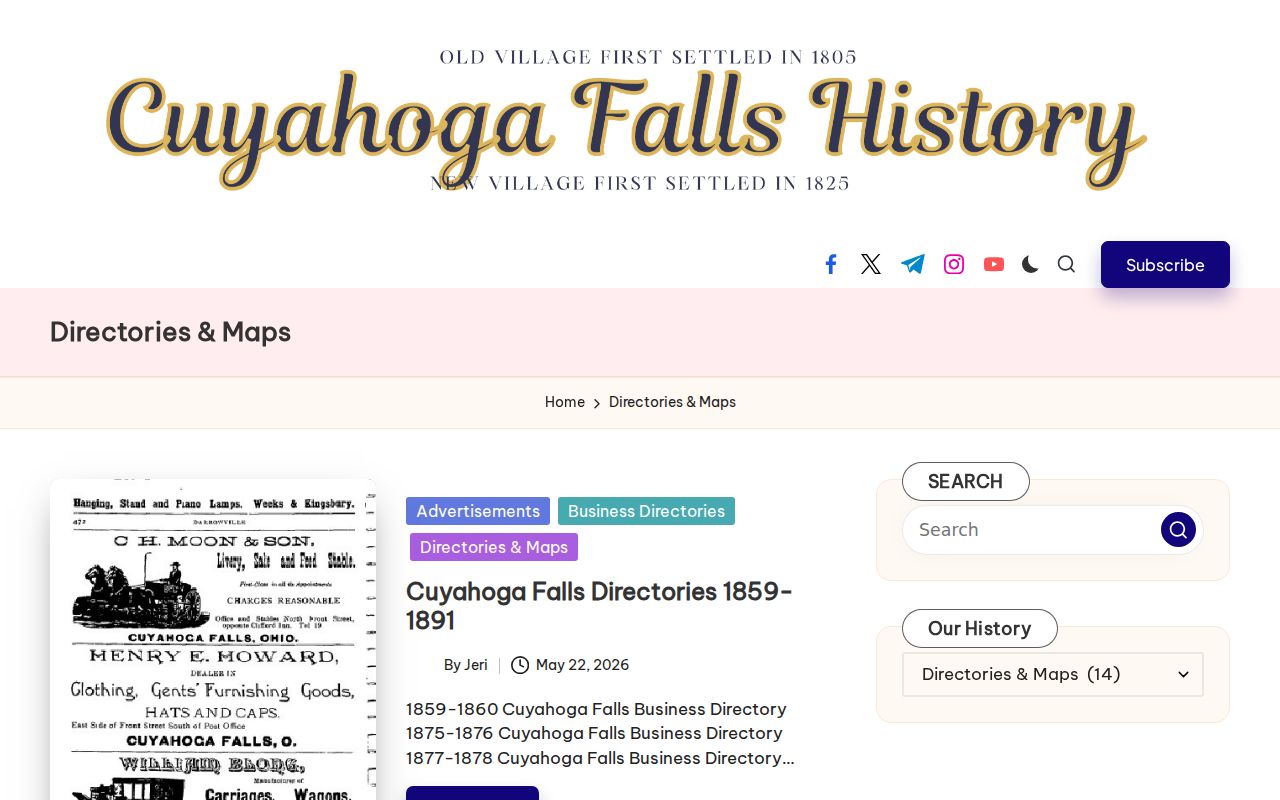
The collection page helps distinguish locally digitized Cuyahoga Falls material from the broader Akron-area series that needs a volume-level inclusion check.
Cuyahoga Falls City Directory Digital Runs
ASCPL's Historic City Directories page describes what residential, business, and street portions commonly provide. Residential entries generally show a spouse name and occupation. Business sections can name owners or officers. Street directories organize residents and businesses by address. Many volumes also add classified listings, clubs, organizations, churches, or statistics. Those broad descriptions guide inspection, but they do not mean every Cuyahoga Falls entry carries every field.
The linked digitized Akron-Summit directory collection is useful for searching a known year. Start with the exact title, then confirm Cuyahoga Falls in its geography or street section. The 1948-49 and later explicitly named editions provide stronger coverage leads than a generic Akron title. When a needed volume is absent online, ASCPL reports Akron directories on microfilm from 1871 to 1978 and Akron-area telephone directories from 1914 onward. Ask staff to identify the exact local inclusion instead of assuming a final city-directory year.
Note: A directory hit fixes a name and address in its publication context, but it should be paired with another dated source before drawing a family conclusion.
Cuyahoga Falls Directory Research Desk
The Cuyahoga Falls Library Local History Collection is upstairs, in the first aisle of adult nonfiction at 2015 Third St. Its local materials include the William A. and Margaretta Taylor Memorial Collection, area directories, high-school yearbooks, and local-history books. The research desk can be reached at 330-928-2117, extension 2000. The Local History Collections page is the best source for current access details and for a library-to-ASCPL referral when an item is not kept on the local shelf.
Its newspaper microfilm can help interpret a directory entry. The Reporter run is December 24, 1870 through December 26, 1952. The News Press run is January 17, 1930 through December 26, 1979, then January 1981 through December 2014. The published dates leave a 1980 gap. That gap matters when a name vanishes from a directory and a newspaper search is used to test a move, death, or business change.
Cuyahoga Falls Library
Local history, yearbooks, directories, newspapers, and in-library genealogy databases. Research desk: 330-928-2117 ext. 2000.
ASCPL Special Collections
Third floor, Main Library, 60 S. High St., Akron. Call 330-643-9030 or email speccollections@akronlibrary.org.
ASCPL keeps material in closed stacks and storage. Requests placed Monday through Saturday may be retrieved that day; Sunday requests do not receive same-day retrieval. Search the Special Collections catalog for a title or locality before contacting the desk.
Reading a Cuyahoga Falls City Directory Entry
A 1943 Cuyahoga Falls sample shows how dense a city directory entry can be. The entry for Fred C. Norte shows a personal name, a spouse in brackets, a compact occupation or business notation, a residence marker, and a street address. The form is useful, but no reader should project those fields onto a different year without looking at that volume's key. A 1941 street volume shows that street pages may also display a route heading, side of street, number, listed household, unit, telephone, vacancy notation, cross streets, boundary clues, or business and institution occupants.
| Printed name | Copy initials, suffixes, and spelling exactly before trying a later record. |
|---|---|
| Bracketed spouse | May appear in the 1943 form; check the particular volume rather than treating it as universal. |
| Work or business notation | Can help separate same-name people when the precise entry and its abbreviations are inspected. |
| Residence marker and address | Connect the listed person to a printed street location for that year. |
| Street-page details | May add units, phone, vacancy, cross-street, or municipal-boundary clues in the relevant volume. |
- Criss-cross directory
- A reverse directory that begins with an address and can point to a listed name or business. Haines Akron and Suburban volumes are the local research-room lead.
- Householder index
- A name-oriented listing for the person or household printed by the directory, not a complete census of all occupants.
- Abbreviation key
- The volume's explanation of compact marks and terms. Read or copy it before expanding a notation.
Cuyahoga Falls City Directory Street Sections
Name listings and address listings answer different questions. A surname section starts with a person. A street or criss-cross section starts with a number and street. The Haines Akron City and Suburban Criss-Cross directories are the documented local fallback for the second task, although ASCPL has not published the exact Haines year run online. Ask Special Collections for an address and approximate period, then confirm what years are available in the research room.
Street entries can help when a family used initials, changed a surname, or appears briefly. A result remains a printed listing, not proof that every person in a household lived there. For a modern address-keyed parcel and recorded-document route, use the separate Cuyahoga Falls street directory resource rather than stretching historical books into current records.
Cuyahoga Falls Directory Yearmarks
The calendar below gives checkpoints for choosing a volume. It is not an uninterrupted local-inclusion claim. Its purpose is to prevent an easy mistake: treating an Akron-area publication title as automatic evidence that every Cuyahoga Falls household appears inside.
- 1859: Williams' Akron, Wooster and Cuyahoga Falls Directory provides an early named title.
- 1859-1891: Cuyahoga Falls History posts local directory materials, including early business examples.
- 1871-1920: The digitized Akron-Summit series lists numerous annual or biennial issues, alongside enumerated exceptions.
- 1939-40 and 1948-49: Burch examples explicitly supply later metropolitan Cuyahoga Falls leads.
- 1964-65 and 1968-69: Named Official City Directory editions explicitly include Cuyahoga Falls.
For research after those printed examples, ASCPL's microfilm and telephone-directory route can be more useful than guessing whether a specific city directory survived or was digitized.
Tracing Cuyahoga Falls City Directory Families
Family research works best when an exact transcription drives the next search. Choose an address or surname and a target year. Read the printed entry, retaining initials and street spelling. Then move to the next available directory, not simply the next calendar year. A gap may reflect publishing, digitization, or local coverage, so the sequence needs a note of what was actually checked. Federal census schedules are released after 72 years, making 1950 and earlier the available census layer at present.
- Transcribe the directory title, publication year, name, address, and relevant abbreviation exactly as printed.
- Check the next available local or metropolitan volume and compare spelling, street number, and household clues.
- Use the closest released census to test the household at the appropriate enumeration date.
- For a death, estate, or marriage question, route the name to Summit Probate and the Ohio History Connection death index.
- Use a parcel or deed only after the address has been tied to a legal description or current parcel.
Summit Probate's estate, marriage, and guardianship records begin in 1840. Its historic birth and death material covers 1869-1908. Those dates make probate a targeted family-history route, not a replacement for a directory.
Cuyahoga Falls Directory Place Names
Old place names can decide whether a search succeeds. Cuyahoga Falls began as Manchester, was platted in 1826, and incorporated in 1836. Later records may also use Northampton Township because the merger was approved in 1985 and became effective in the 1985-86 period. Preserve those names in a search note rather than silently replacing them with a modern city label. Legal descriptions and maps are often the bridge when an old address does not look familiar.
ASCPL's Taylor Memorial and Cuyahoga Falls Collection adds maps, plats, official and legal material, and 1984 merger-study minutes. The local Historical Society at 2083 Cook St. is another route for street, house, cemetery, school, church, and people-in-history context. A historic map can date a street configuration, but it does not establish that a named person occupied a property.
Cuyahoga Falls Directory Trail Endpoints
When a listing stops, test several explanations without overreading the absence. The Cuyahoga Falls Library's newspaper microfilm, the Akron Beacon Journal collection, probate files, and the state death index can provide a dated lead. City cemetery research is another limited route. The city oversees Oakwood, Northampton, Harrington, and Botzum cemeteries, but it says it has no Botzum burial records. A negative search result therefore does not prove a person was never buried in the area.
For cemetery questions, the City directs callers to Cemetery Operations at 330-971-8446 with a name, cemetery, and approximate burial period. Harrington's historic records can include marker-condition notes, which is another reason to treat cemetery information as supporting evidence. These sources are most useful after a directory has supplied a precise name, year, or address.